
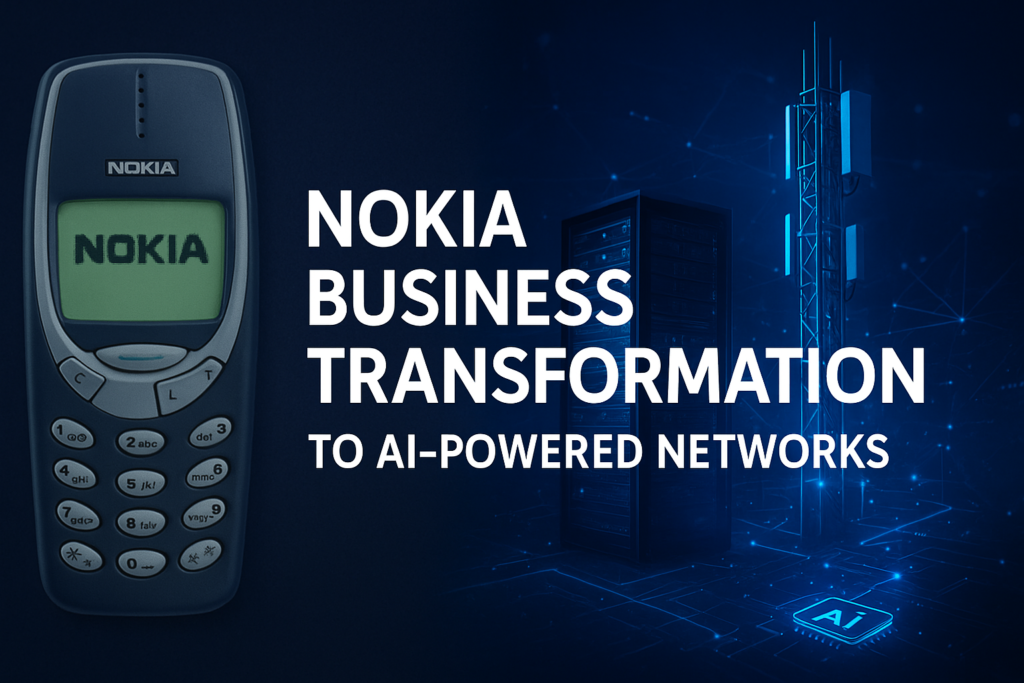
For decades, Nokia was more than a technology company—it was a global symbol of mobile communication. At its peak, Nokia business transformation was not even a discussion because the company dominated over 40% of the global mobile phone market and generated more than €51 billion in annual revenue. From Europe to Asia, a Nokia phone was almost guaranteed to be in every household.
Then came one of the most dramatic collapses in corporate history.
Within a few years, Nokia lost over 90% of its market value, shut down factories, laid off thousands of employees, and became a textbook example of how even the most powerful tech giants can fail. But instead of disappearing like many fallen giants, Nokia executed one of the boldest corporate reinventions of the 21st century—a transformation that repositioned it at the center of AI-powered network infrastructure.
This article explores how Nokia fell, how it survived, and how it is quietly building the backbone of the future digital economy.
Phase 1: When Nokia Lost Its Mobile Phone Crown
Nokia at Its Peak
In 2007, Nokia was unstoppable:
- Market leader in global mobile phones
- Strong brand trust across emerging and developed markets
- Unmatched manufacturing and supply chain efficiency
However, the launch of the Apple iPhone changed the rules of the industry.
The Strategic Miscalculation
Nokia viewed the iPhone as a hardware competitor, not as the beginning of a platform ecosystem. Apple wasn’t selling just a phone—it was selling software, apps, services, and user experience as a single integrated system.
Nokia’s internal problems worsened the situation:
- Leadership underestimated the importance of touch-first interfaces and app ecosystems
- Symbian OS became fragmented and slow to evolve
- Critical decisions about killing legacy systems were delayed
By 2012, Nokia was losing billions, market share collapsed, and consumer perception shifted rapidly toward Android and iOS.
Phase 2: The Decision That Shocked the World
Selling the Phone Business
In 2013, Nokia made a decision that stunned investors and analysts:
- Sold its mobile phone division to Microsoft for €5.44 billion
- Transferred nearly 25,000 employees
- Exited the consumer phone market completely
At the time, this move looked like surrender. In reality, it was strategic survival. Microsoft later wrote off $7.6 billion on the acquisition, proving that Nokia exited at exactly the right moment.
📌 Key Insight:
Nokia didn’t lose its identity—it saved the company by abandoning it.
Phase 3: Betting the Company on Network Infrastructure
The Alcatel-Lucent Acquisition
In 2015, Nokia doubled down on its future by acquiring Alcatel-Lucent for €15.6 billion, paying a significant premium despite still recovering financially.
This acquisition transformed Nokia from a struggling ex-phone maker into a global telecom infrastructure powerhouse.
What Nokia Gained
- Bell Labs, one of the world’s most prestigious research institutions
- Advanced IP routing, optical networking, and fixed broadband technologies
- Tens of thousands of patents and deep intellectual property
As a result, Nokia’s total addressable market expanded from €84 billion to nearly €130 billion.
👉 Internal link suggestion:
How Telecom Infrastructure Shapes the Internet Economy
Phase 4: Rebuilding Nokia’s DNA
A Radical Cultural Reset
One of the most extreme aspects of Nokia’s transformation was its internal reboot:
- Nearly 99% of the workforce changed
- Around 80% of the board replaced
- Almost the entire executive leadership refreshed
This was not a typical turnaround—it was a corporate reboot.
Chairman Risto Siilasmaa famously compared the process to rebuilding an airplane mid-flight and landing it as a completely different aircraft.
📌 SEO & Business Insight:
Without changing people, incentives, and culture, no strategy survives.
Phase 5: Nokia’s Shift Toward AI-Powered Networks
The NVIDIA Partnership
In October 2025, Nokia received major validation when NVIDIA invested $1 billion, acquiring a 2.9% stake in the company. The partnership focuses on AI-RAN (AI-driven Radio Access Networks).
This collaboration combines:
- Nokia’s telecom and 5G/6G expertise
- NVIDIA’s GPU computing and CUDA platform
Why AI-RAN Matters
Telecom networks are evolving into:
- Distributed edge-compute platforms
- AI workload accelerators
- Critical national digital infrastructure
According to industry projections, the AI network infrastructure market could exceed $200 billion by 2030.
👉 External link suggestion:
NVIDIA on AI-powered telecom networks (official NVIDIA blog)
What Nokia Looks Like Today
The modern Nokia is a B2B infrastructure company, not a consumer brand.
Core Business Pillars
- Mobile Networks
- Network Infrastructure (IP, Optical, Fixed)
- Cloud & Network Services
- Patent and Technology Licensing
Key Achievements
- Over €19 billion in revenue (2024)
- Supplies networking equipment to hyperscalers like Microsoft, Google, and Apple
- Built the first 4G network on the Moon for NASA
- Supports 850+ private 5G enterprise networks worldwide
👉 Internal link suggestion:
What Is Private 5G and Why Enterprises Are Adopting It
Challenges Nokia Still Faces
Despite the transformation, Nokia’s journey is not complete:
- Intense competition from Huawei and Ericsson
- Thin margins in mobile networks
- Lost major telecom contracts
- Cyclical capital spending in telecom markets
Geopolitical factors alone have not guaranteed success, making execution and innovation critical.
Key Lessons from Nokia’s Business Transformation
- Kill legacy businesses before they kill the company
- Think in decades, not quarters
- Platforms outperform products
- Deep tech and IP create long-term defensibility
- Reinvention is continuous, not a one-time event
Conclusion
Nokia’s story is no longer about fallen phones—it is about strategic courage. By exiting a dying business, rebuilding its culture, and betting on AI-native network infrastructure, Nokia transformed itself from a failure icon into a critical player in the future of digital connectivity.
The Nokia brand may no longer sit in your pocket, but it is increasingly embedded in the AI-powered networks that will define the next generation of technology.