
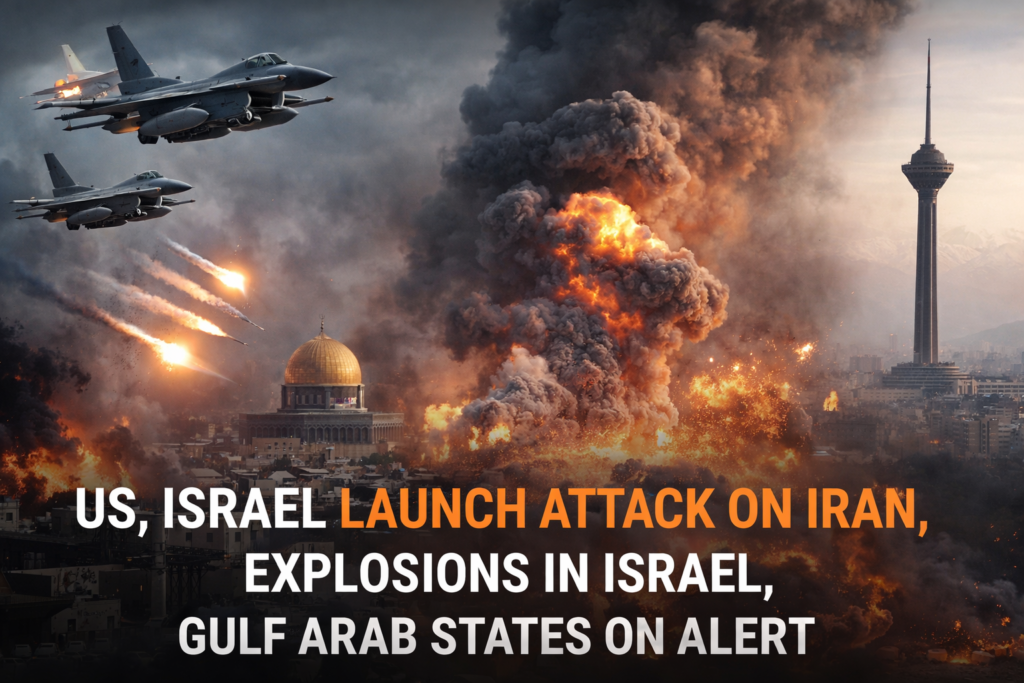
The US and Israel attack on Iran has entered a dramatic and dangerous phase, with multiple missiles striking central Tehran and explosions reported across Israel and several Gulf Arab states. According to Iranian media outlets, strikes hit key areas in the Iranian capital, including University Street and the Jomhouri district, as smoke rose over the city skyline. The escalating confrontation has triggered regional airspace closures and raised fears of a wider Middle East war.
This latest development marks one of the most significant military escalations in recent years, with both sides signaling readiness for further action.
Missiles Strike Tehran: Key Areas Targeted
Iran’s Fars news agency reported that several missiles hit University Street and the Jomhouri area in Tehran. An Al Jazeera correspondent on the ground confirmed that smoke was visible rising from multiple locations in the city.
The semiofficial Tasnim news agency stated that explosions also occurred in the northern Seyyed Khandan area of Tehran.
Other Iranian media reported:
- Attacks in western Ilam province
- Strikes targeting military and defense facilities
- Damage to infrastructure in multiple cities
Israel’s military confirmed carrying out attacks in western Iran, while Iran’s Foreign Ministry said both military targets and civilian infrastructure were struck.
US Confirms Major Combat Operation
US President Donald Trump confirmed that American forces participated in what he described as a “major combat operation in Iran.”
In a public statement, he said:
“Our objective is to defend the American people by eliminating threats from the Iranian regime.”
US officials told Reuters and Al Jazeera that the operation was conducted as a joint US-Israeli military action, involving air and sea strikes. Reports indicate that the US had assembled a significant fleet of fighter jets and naval assets in the region in recent weeks.
Iran Vows “Crushing” Retaliation
Iranian officials responded with strong warnings.
An Iranian official told Reuters that Tehran is preparing retaliation that would be “crushing.” State TV reported that Iran is preparing to “take revenge” and deliver a “strong response.”
A senior Iranian official told Al Jazeera:
- “All American and Israeli assets and interests in the Middle East have become a legitimate target.”
- “There are no red lines after this aggression.”
These statements suggest the conflict could widen beyond Iran and Israel.
Explosions Reported in Israel
Shortly after the strikes on Iran, explosions were heard in northern Israel. The Israeli military said it activated its air defense systems to intercept incoming Iranian missiles.
Key developments:
- Missile interception attempts underway
- Air defense systems including Iron Dome activated
- No immediate reports of casualties or damage
The situation remains fluid as Israel monitors further incoming threats.
Gulf States on High Alert
The conflict quickly spread across the Gulf region.
Countries Reporting Explosions or Alerts:
- Bahrain – Missile attack reportedly targeted the US Navy’s 5th Fleet headquarters.
- Qatar – Defense Ministry confirmed interception of an Iranian missile using Patriot defense systems.
- United Arab Emirates (Abu Dhabi) – Loud explosion reported.
- Kuwait – Explosions reported by regional media.
Following the escalation:
- Qatar, Kuwait, and the UAE closed their airspace.
- Shelter alerts sounded in multiple cities.
- Military defense systems were activated.
Al Jazeera’s correspondent in Doha described the atmosphere as “extremely tense,” with warning sirens sounding across the city.
Why Gulf States Are Involved
Many Gulf Arab states host significant US military bases. According to security experts, Iran may be attempting to:
- Increase pressure on US allies in the region.
- Raise the cost of continued US involvement.
- Push Gulf governments to pressure Washington diplomatically.
Muhanad Seloom, a security analyst in Doha, said Iran is trying to “raise the cost on these countries” and potentially draw them into the conflict.
Israeli Leadership Calls It “Joint Action”
Israeli Prime Minister Benjamin Netanyahu described the strikes as necessary to remove what he called an “existential threat.”
He praised US involvement and said:
“Joint action will create the conditions for the brave Iranian people to take their fate into their own hands.”
According to The Associated Press, one targeted area in Tehran was near offices associated with Supreme Leader Ayatollah Ali Khamenei. Reuters reported that Khamenei has been moved to a secure location and is not currently in Tehran.
Regional Impact and Global Concerns
This escalation has significant implications:
1. Oil Markets
Middle East instability often drives oil prices higher. Analysts expect potential volatility if conflict disrupts shipping routes, particularly the Strait of Hormuz.
2. Airspace Closures
Multiple countries have suspended flights, affecting international travel and trade.
3. Diplomatic Crisis
World leaders are expected to call for emergency diplomatic talks to prevent further escalation.
Possible Next Scenarios
Security experts suggest three possible outcomes:
1️⃣ Limited Military Exchange
Both sides conduct controlled strikes without full-scale war.
2️⃣ Regional War Expansion
Involvement of additional countries or proxy groups.
3️⃣ Emergency Diplomatic Intervention
International mediation reduces hostilities.
The coming hours and days will be critical.
Conclusion
The US and Israel attack on Iran marks a dramatic escalation in Middle East tensions. With missiles striking Tehran, explosions reported in Israel, and Gulf Arab states on high alert, the risk of a broader regional conflict is growing. Iran’s vow of “crushing” retaliation and Israel’s confirmation of joint military operations with the United States indicate that this crisis is far from over.
As air defenses remain active and global markets react, the world is watching closely to see whether diplomacy can contain the situation or whether the conflict expands into a wider war.